Digital Marketing Trends in 2026: 10 Trends Every Business Should Know
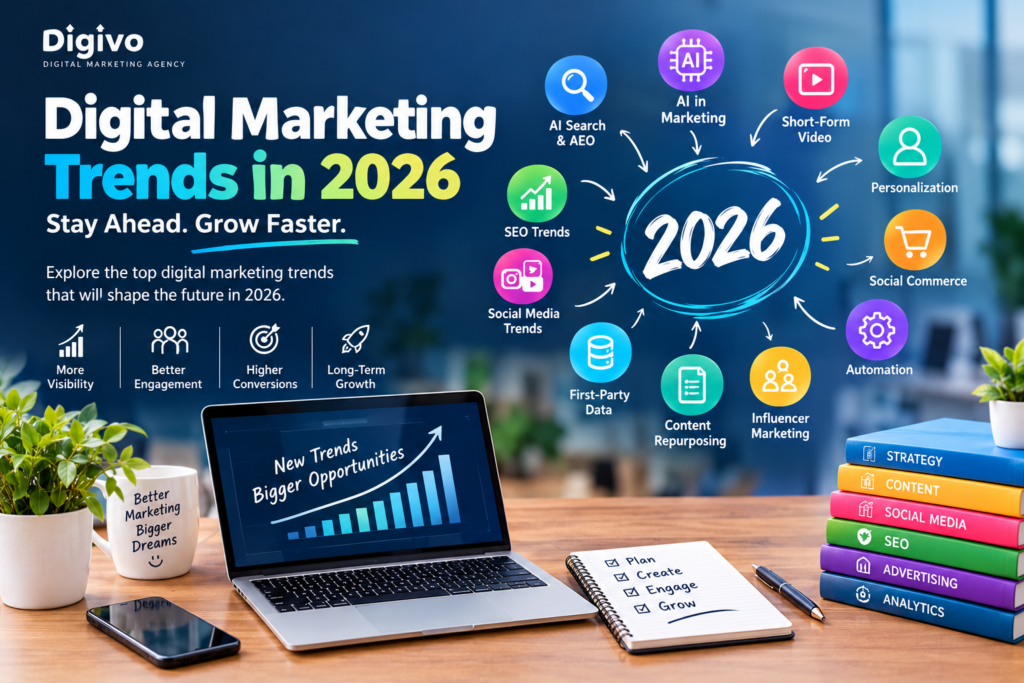
Digital marketing is changing faster than ever. Artificial intelligence, AI-powered search, short-form video, personalization, social commerce, automation, and changing consumer behavior are transforming the way businesses attract and engage customers.
In 2026, businesses can no longer depend on a single marketing channel. Customers discover brands through search engines, social media, videos, AI tools, websites, online communities, and messaging platforms.
For small businesses, startups, and established brands, understanding the latest digital marketing trends 2026 can help create better strategies, reach the right audience, and stay competitive.
In this guide, we will explore the most important digital marketing trends in 2026, how they are changing the industry, and what businesses can do to take advantage of them.
What Is Digital Marketing?
Digital marketing is the promotion of products, services, or brands through digital channels.
These channels include:
- Search engines
- Websites
- Social media
- Online advertising
- Video platforms
- Mobile applications
- Messaging platforms
- AI-powered search and recommendation systems
Digital marketing allows businesses to reach specific audiences, measure campaigns, communicate with customers, and improve marketing strategies using data.
However, the way people discover information online is changing rapidly. That is why businesses need to understand the latest digital marketing trends instead of relying only on traditional SEO or social media strategies.
Top Digital Marketing Trends in 2026
1. AI Is Becoming a Core Part of Digital Marketing
Artificial intelligence is arguably the biggest change happening in digital marketing.
In 2026, marketers are using AI for much more than generating text. AI is being used for:
- Content creation
- Image and video production
- Audience research
- Personalization
- Advertising optimization
- Customer support
- Data analysis
- Marketing automation
- Forecasting
- Brainstorming
- Campaign planning
HubSpot’s 2026 State of Marketing research found that 86.4% of marketing teams surveyed use AI in at least some marketing activities. Content creation, media creation, advertising optimization, and administrative automation are among the major applications.
This means AI is moving from an experimental technology to a regular part of marketing workflows.
What does this mean for businesses?
Businesses don’t necessarily need to replace their marketing teams with AI.
Instead, they can use AI to help their teams work faster.
For example, a marketer could use AI to:
- Research a topic.
- Generate initial content ideas.
- Create a draft.
- Develop social media variations.
- Analyze campaign data.
- Identify opportunities for improvement.
The human marketer still provides strategy, creativity, brand voice, fact-checking, and final judgment.
The future is not simply AI versus humans. It is increasingly humans using AI effectively.
2. AI Search Is Changing SEO
One of the biggest digital marketing trends in 2026 is the transformation of search.
People are increasingly using AI-powered search experiences to ask complex questions and receive summarized answers.
Google has continued expanding AI Overviews and AI Mode. In 2026, Google said AI Mode had surpassed one billion monthly users globally, while AI Mode queries had more than doubled each quarter since launch.
This changes the traditional search experience.
Previously, someone might search:
“Best digital marketing agency in India”
and browse a list of websites.
With AI-powered search, a user may instead ask:
“Which digital marketing agency is best for a small business in India with a limited budget?”
The search experience can become more conversational and detailed.
What Is This Doing to SEO?
SEO is not disappearing.
Instead, it is becoming broader.
Businesses should continue focusing on:
- Helpful content
- Search intent
- Website quality
- Technical SEO
- Author expertise
- Original research
- Strong internal linking
- Clear answers
- Brand authority
- First-hand experience
Google’s AI search features are designed to continue surfacing web content and links, so creating useful, trustworthy content remains important.
3. Answer Engine Optimization Is Becoming More Important
As AI-powered search grows, marketers are paying more attention to Answer Engine Optimization (AEO).
AEO focuses on creating content that clearly answers questions and can be understood and referenced by answer engines and AI-powered search experiences.
For example, instead of writing an article only around:
“SEO”
you could create content answering specific questions such as:
- What is SEO?
- How does SEO work?
- How long does SEO take?
- How much does SEO cost?
- Is SEO useful for small businesses?
- What are the best SEO strategies?
This makes your content more useful to humans and easier for search systems to understand.
How to Optimize Content for AI Search
Focus on:
- Clear headings
- Direct answers
- Question-based sections
- Original information
- Examples
- Statistics from credible sources
- Expert insights
- Structured content
- Internal links
- Strong topical coverage
Don’t write content simply to manipulate an AI system.
Create content that genuinely solves the user’s problem.
4. Personalization Is Becoming a Major Marketing Advantage
Customers increasingly expect businesses to understand their needs.
Instead of showing the same message to everyone, brands can use data and AI to create more relevant experiences.
For example, an online clothing store could show different recommendations based on:
- Previous purchases
- Browsing behavior
- Location
- Interests
- Preferred categories
- Previous interactions
HubSpot’s 2026 marketing research identifies AI-powered personalized content as its top marketing trend, with 48.57% of surveyed marketers identifying it as a leading trend. The research also reports that 93.2% of marketers say personalized or segmented experiences have resulted in more leads and purchases.
Why Personalization Matters
Imagine receiving an advertisement for a product you have no interest in.
You will probably ignore it.
Now imagine receiving content directly related to something you recently searched for.
It is more likely to attract your attention.
Personalization helps businesses make marketing more relevant.
However, personalization should be useful rather than invasive. Businesses should respect privacy and handle customer data responsibly.
5. Short-Form Video Continues to Dominate
Short-form video remains one of the most important content formats in 2026.
Platforms such as:
- YouTube
- TikTok
continue to provide businesses with opportunities to reach audiences through video.
HubSpot’s 2026 State of Marketing research found that short-form video was the highest-ROI media format among surveyed marketers, ahead of long-form video, livestreaming, user-generated content, and blog posts.
Why Does Short-Form Video Work?
Short videos can:
- Grab attention quickly
- Explain products
- Demonstrate services
- Educate customers
- Tell stories
- Show behind-the-scenes content
- Build brand personality
For example, a digital marketing agency could create a 30-second video explaining:
“3 SEO mistakes that are hurting your website.”
A restaurant could show:
“How our signature dish is prepared.”
A fitness business could create:
“3 common mistakes beginners make at the gym.”
The key is not simply creating videos.
The key is creating videos that provide a reason for people to watch.
6. Social Media Is Becoming More Than a Marketing Channel
Social media is no longer simply a place to publish posts.
It is becoming a combination of:
Discovery + Search + Community + Shopping + Customer Service
Consumers can discover products, research brands, communicate with companies, and sometimes purchase products without leaving the platform.
HubSpot’s 2026 research identifies social media as a cornerstone of modern marketing. Organic social and paid social remain widely used, while social shopping is also among the impactful channels identified by marketers.
Instagram Is Particularly Important
HubSpot’s 2026 research found Instagram had become the most leveraged social platform among surveyed brands, slightly ahead of Facebook. Short-form video, visual storytelling, influencer marketing, and social commerce are among the reasons marketers are investing in it.
For small businesses, this means social media should be treated as part of the overall customer journey.
A potential customer might:
See a Reel → Visit profile → Read reviews → Visit website → Send WhatsApp message → Become a customer
Your social media strategy should support that entire journey.
7. Social Search Is Growing
People don’t always use Google to discover information anymore.
They may search directly on:
- YouTube
- TikTok
- Other online communities
This is particularly important for younger audiences.
For example, someone looking for:
“Best cafes in Delhi”
may use Google.
But they might also search Instagram or YouTube to see actual photos, videos, reviews, and recommendations.
This means businesses need to think beyond traditional Google SEO.
How to Optimize for Social Search
Use relevant keywords in:
- Social media captions
- Video titles
- Descriptions
- Profile bios
- Hashtags where appropriate
- On-screen text
- YouTube descriptions
More importantly, create content that answers real customer questions.
8. Influencer Marketing Is Becoming More Strategic
Influencer marketing is evolving.
Brands are increasingly looking beyond celebrity influencers and considering creators with smaller but highly engaged audiences.
Micro-influencers can be valuable because they often have strong relationships with specific communities.
For example:
A local fitness brand might collaborate with a fitness creator who has 20,000 highly relevant followers instead of spending a large amount on a celebrity with millions of unrelated followers.
The key questions are:
- Is the audience relevant?
- Does the creator have credibility?
- Is engagement genuine?
- Does the creator match the brand?
- Can the campaign be measured?
Influencer marketing should be treated as a strategic partnership rather than simply paying someone to promote a product.
9. First-Party Data Is Becoming More Valuable
Privacy changes and evolving advertising systems are making customer-owned data increasingly important.
First-party data is information a business collects directly from its customers or audience.
Examples include:
- Email subscribers
- Customer purchase history
- Website interactions
- Account information
- Customer preferences
- Direct enquiries
Businesses can use this information to improve customer experiences and marketing campaigns, while following applicable privacy and consent requirements.
Why First-Party Data Matters
Imagine that you have 10,000 followers on Instagram.
You don’t control the platform.
But if you have a permission-based email list of customers and prospects, you have a direct communication channel.
This is why businesses should not depend entirely on social media platforms.
A strong digital marketing strategy should combine:
Website + SEO + Social Media + Email + First-Party Data
10. Content Repurposing Is Becoming Essential
Creating high-quality content takes time.
One solution is content repurposing.
Instead of creating every piece of content from scratch, businesses can turn one valuable piece of content into multiple formats.
For example:
One Blog Post
↓
YouTube video
↓
Instagram Reel
↓
LinkedIn post
↓
Instagram carousel
↓
Email newsletter
↓
Short video
↓
Pinterest graphic
This approach allows businesses to reach different audiences without completely rebuilding the content each time.
AI tools can also help marketers adapt content into different formats. HubSpot’s 2026 research identifies repurposing content across channels as one of the major marketing trends.
However, don’t simply copy and paste the same content everywhere.
Adapt the message to the platform.
11. Human Creativity Is Becoming More Valuable
It might seem strange that AI would make human creativity more important.
But there is a reason.
AI makes it easier for almost everyone to create content.
That means the internet can become saturated with similar:
- Blog posts
- Images
- Videos
- Captions
- Advertisements
When everyone can create content quickly, original ideas and strong brand identity become more valuable.
HubSpot’s 2026 social media research highlights the challenge of AI-generated content becoming more common and argues that brands need stronger points of view and differentiation.
Businesses should therefore focus on:
- Original stories
- Real experiences
- Expert opinions
- Case studies
- Customer stories
- Unique research
- Strong brand personality
AI can help produce content.
But your brand needs something worth saying.
12. Marketing Automation Is Becoming Smarter
Marketing automation allows businesses to automate repetitive marketing tasks.
Examples include:
- Email sequences
- Lead nurturing
- Customer segmentation
- Appointment reminders
- Follow-up messages
- Social media workflows
- Advertising optimization
- Customer support
AI is making automation more intelligent.
Instead of simply following a fixed sequence, modern systems can use customer behavior and data to determine what message should come next.
For small businesses, automation can save time and make follow-up more consistent.
What Does the Future of Digital Marketing Look Like?
The future of digital marketing will probably not be about choosing between AI, SEO, social media, or traditional digital channels.
Instead, successful businesses will connect multiple channels.
A customer might discover a company through:
Google Search
↓
AI Search
↓
↓
YouTube
↓
Website
↓
↓
↓
Purchase
This means businesses need to think about the entire customer journey.
Marketing channels should not operate separately.
They should work together.
How Small Businesses Can Use These Digital Marketing Trends
You don’t need a huge budget to start.
A small business can begin with five simple steps.
Step 1: Build a Strong Website
Your website should clearly explain:
- Who you are
- What you offer
- Who you help
- Why customers should choose you
- How customers can contact you
Step 2: Invest in SEO
Create useful content around questions your customers actually ask.
Focus on:
- Search intent
- Local SEO
- On-page SEO
- Technical SEO
- Helpful content
- Internal linking
Step 3: Use Social Media Consistently
Choose one or two platforms where your audience is active.
Don’t try to manage every platform at once.
Step 4: Use AI as a Marketing Assistant
Use AI to help with:
- Research
- Brainstorming
- Content ideas
- Repurposing
- Data analysis
- Marketing automation
But always add human review and expertise.
Step 5: Measure Results
Track:
- Website traffic
- Leads
- Engagement
- Conversions
- Sales
- Customer acquisition cost
- Return on advertising spend
Don’t measure success only by followers or likes.
Digital Marketing Trends 2026: Quick Summary
Here are the most important trends to remember:
| Trend | Why It Matters |
|---|---|
| AI in Marketing | Improves productivity and personalization |
| AI Search | Changes how people discover information |
| AEO | Helps businesses adapt to answer-based search |
| Personalization | Makes marketing more relevant |
| Short-Form Video | Strong engagement and ROI potential |
| Social Search | Customers discover brands on social platforms |
| Influencer Marketing | Builds trust within specific communities |
| First-Party Data | Gives businesses stronger customer relationships |
| Content Repurposing | Increases content efficiency |
| Human Creativity | Helps brands stand out from AI-generated content |
| Marketing Automation | Saves time and improves follow-up |
Frequently Asked Questions
What are the biggest digital marketing trends in 2026?
The biggest trends include AI-powered marketing, AI search, personalization, short-form video, social commerce, social search, automation, first-party data, and content repurposing.
Is digital marketing still important in 2026?
Yes. Digital marketing remains an important way for businesses to reach customers through search, websites, social media, email, video, advertising, and other digital channels.
How is AI changing digital marketing?
AI is helping marketers with content creation, personalization, media production, advertising optimization, automation, research, forecasting, and customer experiences.
Will AI replace SEO?
AI is changing search, but SEO remains important. Businesses still need high-quality websites and useful content that can be discovered and understood by search engines and AI-powered search experiences.
What is AEO?
AEO stands for Answer Engine Optimization. It refers to optimizing content so that it clearly answers questions and is easier for answer engines and AI-powered search systems to understand and reference.
Is social media marketing still effective in 2026?
Yes. Social media remains one of the major digital marketing channels. Short-form video, social commerce, influencer marketing, community building, and direct messaging are important opportunities for businesses.
Should small businesses use AI for marketing?
Yes, when used strategically. AI can help small businesses save time and improve productivity, but human expertise, creativity, fact-checking, and brand strategy remain essential.
Conclusion
The digital marketing trends in 2026 show that the industry is moving toward a more intelligent, personalized, and interconnected marketing ecosystem.
AI is changing how content is created and how people search for information. Social media is becoming a discovery, shopping, and customer-service channel. Short-form video continues to attract attention, while personalization and first-party data are becoming increasingly important.
But technology alone does not guarantee marketing success.
Businesses still need a clear strategy, a strong brand, useful content, customer understanding, and measurable goals.
The businesses that succeed in 2026 will not necessarily be the ones using the most technology.
They will be the ones that use technology intelligently while maintaining human creativity, trust, and genuine value for customers.
The future of digital marketing is not just about being seen. It is about being useful, relevant, trusted, and memorable.