10 AI Tools Every Digital Marketer Should Know in 2026
Artificial intelligence has changed the way digital marketing works.
From creating content and designing social media posts to researching keywords, analyzing campaigns, generating videos, and automating repetitive tasks, AI marketing tools are helping marketers work faster and smarter.
In 2026, AI is no longer simply an experimental technology for marketers. It has become part of everyday marketing workflows. HubSpot’s 2026 State of Marketing research reports that 86.4% of marketing teams use AI in at least some areas, with content creation, media creation, advertising optimization, automation, and brainstorming among common applications.
But there is one problem:
There are hundreds of AI tools available. Which ones are actually useful for digital marketers?
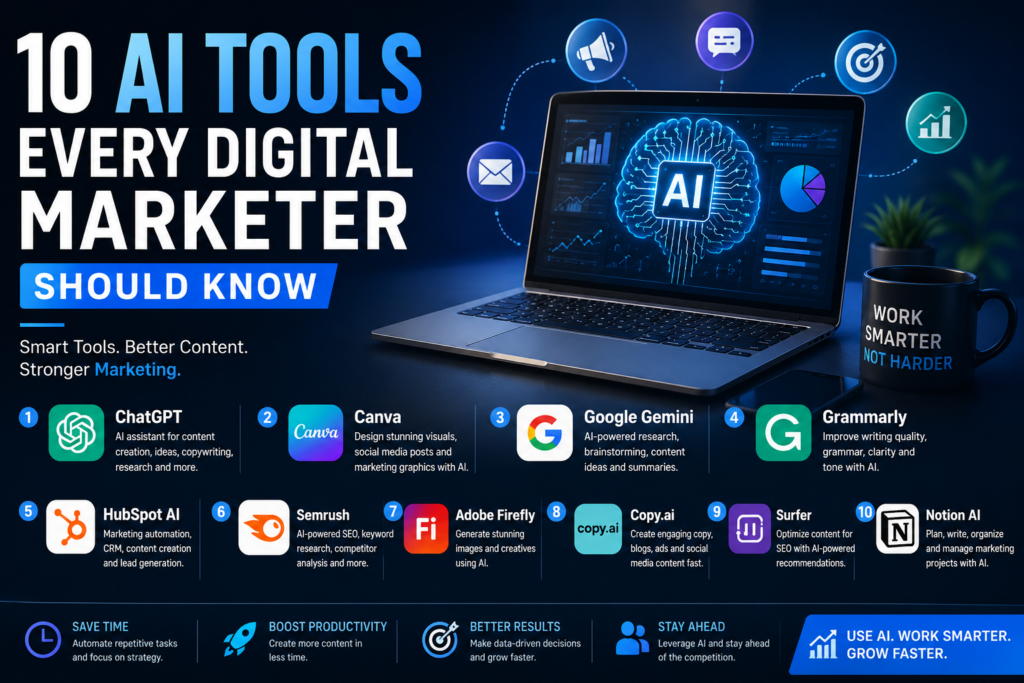
In this guide, we’ll explore 10 AI tools every digital marketer should know in 2026, what each tool does, how marketers can use it, and which marketing tasks it is best suited for.
What Are AI Marketing Tools?
AI marketing tools are software applications that use artificial intelligence to help marketers perform tasks such as:
- Content creation
- SEO and keyword research
- Social media marketing
- Graphic design
- Video creation
- Email marketing
- Data analysis
- Customer engagement
- Marketing automation
- Campaign optimization
Instead of replacing marketers completely, these tools can reduce repetitive work and give marketers more time to focus on strategy, creativity, research, and decision-making.
Canva describes AI marketing tools as software that uses technologies such as machine learning, natural language processing, and data analytics to support, automate, and improve marketing activities.
Why Should Digital Marketers Use AI in 2026?
AI can help marketers accomplish more in less time.
According to HubSpot’s 2026 marketing research, AI adoption is now widespread, with content creation, media creation, advertising optimization, administrative automation, and strategic planning among the major use cases.
Here are some of the biggest benefits.
1. Save Time
AI can help with repetitive tasks such as:
- Generating ideas
- Writing first drafts
- Summarizing information
- Creating social posts
- Analyzing data
- Repurposing content
2. Create Content Faster
Marketers can use AI to generate initial drafts for:
- Blog posts
- Social media captions
- Emails
- Ad copy
- Product descriptions
- Video scripts
Human editing and fact-checking are still important.
3. Improve Productivity
AI allows marketers to automate parts of their workflow and spend more time on strategic activities.
4. Personalize Marketing
AI can analyze customer information and help marketers create more relevant messages and experiences.
HubSpot’s 2026 research identifies AI-powered personalized content as one of the leading marketing trends.
5. Analyze Marketing Data
AI can help marketers identify patterns in:
- Website traffic
- Customer behavior
- Campaign performance
- Conversion rates
- Advertising data
10 Best AI Tools for Digital Marketers in 2026
Let’s look at the tools.
1. ChatGPT
Best for: Content creation, brainstorming, research assistance, strategy, and marketing workflows
ChatGPT is one of the most versatile AI tools available to digital marketers.
Marketers can use it for almost every stage of the content and marketing process.
How digital marketers can use ChatGPT
You can use ChatGPT to:
- Generate blog ideas
- Create content outlines
- Write social media captions
- Brainstorm campaign concepts
- Create email drafts
- Generate ad-copy variations
- Develop buyer personas
- Create content calendars
- Rewrite content
- Create video scripts
- Analyze marketing data
- Generate SEO content briefs
For example, instead of asking:
“Write a blog post about SEO.”
A better marketing prompt would be:
“Create a 2,000-word beginner-friendly SEO guide for small businesses. Include keyword research, on-page SEO, technical SEO, local SEO, FAQs, and a practical checklist.”
The more context you provide, the more useful the output can become.
Best use
ChatGPT is particularly useful as an AI marketing assistant for brainstorming, planning, drafting, analysis, and workflow support.
OpenAI also positions ChatGPT Work as a tool for marketing teams to work across customer and campaign context and connect with marketing-related tools.
2. Canva AI
Best for: Social media graphics, presentations, images, marketing designs, and visual content
Visual content is extremely important in digital marketing.
Canva combines traditional design tools with AI-powered features that can help marketers create visual assets faster.
What can marketers create with Canva?
You can create:
- Instagram posts
- Instagram Stories
- YouTube thumbnails
- LinkedIn graphics
- Presentation slides
- Infographics
- Blog graphics
- Advertisements
- Posters
- Social media banners
- Marketing videos
Canva’s 2026 AI marketing guidance highlights AI as a way to speed up ideation, content production, personalization, and optimization while keeping human creative direction important.
Best use
Canva AI is ideal for marketers who need professional visual content without advanced graphic-design skills.
3. Semrush
Best for: SEO, keyword research, competitor analysis, and AI-search visibility
SEO remains one of the most important digital marketing channels, but SEO is changing rapidly because of AI-powered search.
Semrush provides tools for:
- Keyword research
- Competitor analysis
- SEO auditing
- Content optimization
- Rank tracking
- Backlink research
- AI-search optimization
- Content marketing
Semrush is particularly useful when you need data rather than simply generating content.
Recent 2026 coverage of AI content marketing tools highlights Semrush as a unified platform combining SEO, AI content capabilities, and AI-search optimization.
Best use
Use Semrush when your primary goal is SEO research, competitor analysis, and search visibility.
4. HubSpot AI
Best for: Marketing automation, CRM, content, lead generation, and customer engagement
HubSpot has integrated AI across its marketing ecosystem.
Its AI capabilities can help marketers with:
- Content creation
- Blog ideas
- Marketing emails
- Customer engagement
- CRM activities
- Lead management
- Automation
- Campaign workflows
HubSpot’s current AI platform guidance includes AI capabilities for content creation, marketing, conversational experiences, and analysis.
Best use
HubSpot AI is especially useful for businesses that want to connect:
Marketing + CRM + Sales + Customer Data
within one ecosystem.
5. Grammarly
Best for: Writing, grammar, editing, and brand communication
Even experienced marketers make writing mistakes.
Grammarly can help improve:
- Grammar
- Spelling
- Sentence structure
- Clarity
- Tone
- Professional communication
For digital marketers, this can be useful when creating:
- Emails
- Blog posts
- Website copy
- Social media content
- Ad copy
- Business proposals
Best use
Use Grammarly as a final editing and quality-control layer before publishing marketing content.
It works particularly well alongside generative AI because AI-generated drafts can still require human editing.
6. Jasper
Best for: AI-powered marketing content and brand-focused content creation
Jasper is designed specifically around marketing workflows.
It can help teams create content for:
- Blog posts
- Social media
- Advertising
- Email campaigns
- Website pages
- Marketing campaigns
One of its major advantages is its focus on maintaining brand voice and marketing consistency.
HubSpot’s 2026 review describes Jasper as an AI copilot for marketing teams producing high-volume, on-brand content across channels.
Best use
Jasper is particularly useful for marketing teams and agencies producing large amounts of branded content.
7. Copy.ai
Best for: Marketing workflows, sales content, and repetitive go-to-market tasks
Copy.ai has increasingly moved beyond basic AI copywriting toward workflow automation.
Marketers can use AI workflows to assist with repetitive processes such as:
- Content creation
- Sales prospecting
- Marketing operations
- Campaign workflows
- Lead-related tasks
- Content repurposing
The important idea is that AI isn’t only about writing.
The future of AI marketing is increasingly about workflows and automation.
8. Midjourney
Best for: AI-generated creative images and visual concepts
Digital marketers constantly need visual content.
Midjourney can help marketers explore creative concepts and generate visual assets for campaigns.
Potential applications include:
- Campaign concepts
- Creative inspiration
- Social media visuals
- Advertising concepts
- Brand moodboards
- Marketing illustrations
- Concept images
However, marketers should check licensing, brand suitability, factual accuracy, and platform policies before using AI-generated assets commercially.
Best use
Midjourney is best for marketers who need creative visual concepts and AI-generated imagery.
9. Descript
Best for: AI-assisted video and audio editing
Video marketing continues to be an important part of digital marketing.
Descript uses AI-assisted workflows to make video and audio editing easier.
Marketers can use video tools for:
- YouTube videos
- Podcasts
- Social media videos
- Interviews
- Tutorials
- Short-form videos
- Video advertisements
Instead of treating video editing as a highly technical process, AI-assisted editing can make it easier for marketers to create and repurpose content.
Best use
Descript is useful for marketers who regularly create video and audio content.
10. Zapier AI
Best for: Marketing automation and connecting different applications
Imagine receiving a lead from a website form.
Instead of manually:
- Checking the form
- Adding the lead to a spreadsheet
- Sending an email
- Updating your CRM
- Notifying your sales team
automation can connect these steps.
Zapier can help marketers automate workflows between different applications.
Examples include:
Website form → CRM → Email → Sales notification
or:
New blog post → Social media workflow → Content distribution
Best use
Zapier is ideal for automating repetitive marketing processes across different platforms.
AI Marketing Tools Comparison
| AI Tool | Best For | Beginner Friendly |
|---|---|---|
| ChatGPT | Content, ideas & strategy | ⭐⭐⭐⭐⭐ |
| Canva AI | Design & social media | ⭐⭐⭐⭐⭐ |
| Semrush | SEO & keyword research | ⭐⭐⭐⭐ |
| HubSpot AI | CRM & automation | ⭐⭐⭐⭐ |
| Grammarly | Writing & editing | ⭐⭐⭐⭐⭐ |
| Jasper | Marketing content | ⭐⭐⭐⭐ |
| Copy.ai | Marketing workflows | ⭐⭐⭐⭐ |
| Midjourney | AI images | ⭐⭐⭐⭐ |
| Descript | Video & audio | ⭐⭐⭐⭐ |
| Zapier AI | Automation | ⭐⭐⭐⭐ |
How to Choose the Right AI Marketing Tool
You don’t need every AI tool available.
Instead, choose tools based on your marketing objectives.
If you create blog content
Consider:
ChatGPT + Grammarly + Semrush
If you manage social media
Consider:
ChatGPT + Canva AI + video tools
If you focus on SEO
Consider:
Semrush + ChatGPT + Google Search Console
If you run an agency
Consider:
ChatGPT + Canva + Semrush + HubSpot + automation tools
If you focus on video marketing
Consider:
ChatGPT + Canva + Descript
How to Use AI Tools Without Losing the Human Touch
AI can make marketing faster, but more AI-generated content doesn’t automatically mean better marketing.
This is one of the biggest lessons for marketers in 2026.
Canva’s 2026 marketing research emphasizes that as AI increases content production, human creative direction, judgment, taste, and cultural understanding become increasingly important.
A good workflow is:
Step 1: Human Strategy
Decide:
- Who is your audience?
- What problem are you solving?
- What is your objective?
- What message do you want to communicate?
Step 2: AI Assistance
Use AI to:
- Brainstorm
- Research
- Draft
- Analyze
- Repurpose
Step 3: Human Editing
Check:
- Accuracy
- Brand voice
- Originality
- Examples
- Facts
- Tone
Step 4: Human Creativity
Add:
- Personal experience
- Original insights
- Unique examples
- Brand personality
- Customer stories
Step 5: Measure Results
Check:
- Traffic
- Engagement
- Leads
- Conversions
- Revenue
This approach gives you the speed of AI without turning your brand into generic AI content.
AI Marketing Trends to Watch in 2026
AI marketing is moving beyond simple content generation.
Here are several trends marketers should watch.
1. AI-Powered Personalization
AI can help brands create more personalized experiences for different audiences.
2. AI Search Optimization
Search is changing as consumers increasingly interact with AI-powered search experiences.
HubSpot’s 2026 State of Marketing report identifies adapting SEO for search changes as one of the leading trends marketers are working on.
3. Marketing Automation
AI is increasingly being connected to workflows rather than used only as a standalone chatbot.
4. AI Video Creation
AI-assisted video creation and editing are making video production more accessible.
5. AI-Powered Analytics
AI can help marketers identify patterns and insights in large amounts of marketing data.
6. AI Agents
The next step is moving from AI that simply responds to prompts toward systems that can perform multi-step marketing tasks.
Common Mistakes When Using AI for Marketing
Mistake 1: Publishing AI Content Without Editing
Always review important content.
Mistake 2: Using AI for Everything
Strategy still requires human judgment.
Mistake 3: Ignoring Brand Voice
Your content should sound like your brand, not like a generic AI system.
Mistake 4: Creating Content Just for SEO
Don’t create hundreds of low-value pages simply because AI makes content cheap.
Mistake 5: Trusting AI Without Verification
AI can produce inaccurate or outdated information.
Check important facts, statistics, product information, and claims before publishing.
A Simple AI Marketing Workflow for Beginners
If you’re new to AI marketing, don’t try to learn ten tools at once.
Start with this simple workflow:
Research
Semrush / Google Search
↓
Brainstorm
ChatGPT
↓
Write
ChatGPT + human editing
↓
Design
Canva AI
↓
Publish
WordPress
↓
Promote
Social media
↓
Analyze
Google Analytics + Search Console
↓
Automate
Zapier
This workflow can help a small marketing team accomplish more without creating an unnecessarily complicated technology stack.
Frequently Asked Questions
What are the best AI tools for digital marketing in 2026?
Some of the most useful AI marketing tools include ChatGPT, Canva AI, Semrush, HubSpot AI, Grammarly, Jasper, Copy.ai, Midjourney, Descript, and Zapier. The best tool depends on your marketing objective and workflow.
What is the best AI tool for digital marketing?
There isn’t one tool that is best for every marketer. ChatGPT is a strong general-purpose option, while tools such as Semrush, Canva, HubSpot, and Zapier are more specialized.
Can AI replace digital marketers?
AI can automate many repetitive tasks, but it does not eliminate the need for strategy, creativity, judgment, customer understanding, and decision-making. In 2026, the competitive advantage increasingly comes from marketers who know how to combine AI with human expertise.
How can AI help with SEO?
AI can help with keyword research, content ideation, outlines, content optimization, competitor analysis, data analysis, and content repurposing. However, marketers should still evaluate search intent, accuracy, originality, and user experience.
Are AI marketing tools free?
Some AI marketing tools offer free plans or free features, while others require paid subscriptions. Features, limits, and pricing can change, so check the provider’s current pricing before choosing a tool.
How many AI tools does a digital marketer need?
You don’t need dozens of tools. A beginner can start with three or four tools that cover the most important tasks: content, SEO, design, and analytics/automation.
Final Thoughts
AI has become one of the most important technologies in digital marketing.
The biggest opportunity isn’t simply using AI to create more content.
It’s using AI to become a smarter, faster, and more strategic marketer.
Tools such as ChatGPT can help with ideas and content, Canva can accelerate visual creation, Semrush can support SEO research, HubSpot can connect marketing with customer data, and automation tools can reduce repetitive work.
But remember:
AI is the tool. The marketer is still the strategist.
The best digital marketers in 2026 will not be the people who use the most AI tools.
They will be the people who know which tool to use, when to use it, and how to combine AI with human creativity and marketing strategy.
Start with one tool, learn it properly, integrate it into your workflow, measure the results, and then expand your AI marketing stack.
Use AI to work faster. Use strategy to work smarter. Use creativity to stand out.