
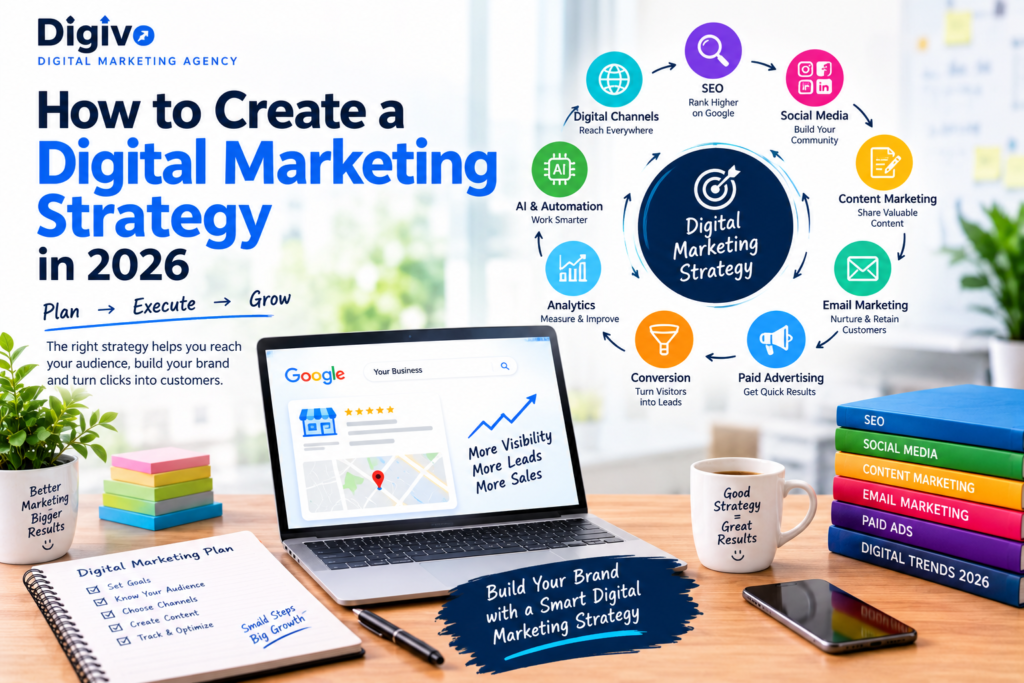
How to Create a Digital Marketing Strategy: Complete Guide for 2026
In today’s competitive online market, simply having a website or social media account is not enough. Businesses need a clear plan to reach the right audience, attract potential customers, build trust, and convert visitors into paying customers.
This is where a digital marketing strategy becomes important.
A well-planned digital marketing strategy helps businesses understand their target audience, select the right marketing channels, create valuable content, generate leads, increase sales, and measure results.
Whether you are a startup, small business, freelancer, e-commerce brand, or established company, having a structured digital marketing plan can help you use your time and marketing budget more effectively.
In this guide, you’ll learn how to create a digital marketing strategy from scratch, including SEO, social media marketing, content marketing, paid advertising, email marketing, AI, analytics, and conversion optimization.
What Is a Digital Marketing Strategy?
A digital marketing strategy is a structured plan that explains how a business will use digital channels to achieve its marketing and business goals.
These channels can include:
- Search engines
- Websites
- Social media
- Online advertising
- Content marketing
- Video platforms
- Google Business Profile
- Influencer marketing
- AI-powered marketing platforms
For example, if your goal is to generate more leads, your strategy might include:
SEO → Content → Social Media → Landing Page → Lead Form → Email Follow-Up → Sales
A strategy connects all these activities instead of treating each marketing channel separately.
Why Is a Digital Marketing Strategy Important?
Without a strategy, businesses often post content randomly, run advertisements without clear goals, or spend money on channels that don’t produce meaningful results.
A digital marketing strategy gives your marketing activities direction.
A good strategy can help you:
- Increase brand awareness
- Reach your target audience
- Generate qualified leads
- Increase website traffic
- Improve search visibility
- Build customer trust
- Increase online sales
- Improve customer retention
- Measure marketing performance
- Reduce wasted advertising spend
The goal isn’t simply to get more traffic.
The goal is to attract the right traffic and turn that traffic into meaningful business results.
How to Create a Digital Marketing Strategy
Creating a successful strategy doesn’t have to be complicated.
You can follow this simple framework:
Research → Goals → Audience → Positioning → Channels → Content → Campaigns → Conversion → Measurement → Optimization
Let’s break down each step.
1. Understand Your Business
Before choosing digital marketing channels, understand your business.
Ask yourself:
- What products or services do we offer?
- Who are our customers?
- What problem do we solve?
- What makes us different?
- What are our strongest products or services?
- Who are our competitors?
- What is our current online presence?
For example, a local gym and an online software company should not use exactly the same marketing strategy.
A gym may focus heavily on:
- Google Business Profile
- Local SEO
- Short-form video
- Local advertising
- Customer reviews
A software company may focus more on:
- SEO
- Content marketing
- Email marketing
- Webinars
- Google Ads
Your business model should influence your strategy.
2. Define Your Marketing Goals
The next step is setting clear goals.
Don’t simply say:
“I want more customers.”
Make the goal specific and measurable.
Examples of digital marketing goals:
- Increase website traffic by 30% in six months
- Generate 100 qualified leads per month
- Increase online sales by 20%
- Reach 10,000 monthly organic visitors
- Increase email subscribers by 1,000
- Generate 50 local leads every month
- Improve conversion rate from 2% to 4%
A useful framework for setting goals is SMART:
S — Specific
M — Measurable
A — Achievable
R — Relevant
T — Time-bound
For example:
“Generate 100 qualified leads from organic search within six months.”
That’s much better than simply saying:
“Get more leads.”
3. Identify Your Target Audience
One of the biggest mistakes businesses make is trying to market to everyone.
Your strategy becomes much stronger when you clearly understand your ideal customer.
Create an ideal customer profile.
Consider:
- Age
- Location
- Occupation
- Income level
- Interests
- Problems
- Buying behavior
- Online habits
- Preferred platforms
- Purchase motivations
Example
Suppose you operate a digital marketing agency.
Your target audience could be:
Small business owners aged 25–50 who want more leads and sales through Google, social media, and their website but don’t have an in-house marketing team.
Now your content becomes easier to create because you know who you’re talking to.
4. Research Your Competitors
Competitor research is an important part of a digital marketing plan.
Find businesses competing for the same customers.
Analyze:
- Their website
- SEO keywords
- Blog topics
- Social media
- Advertising
- Content formats
- Offers
- Reviews
- Landing pages
- Customer engagement
Don’t simply copy your competitors.
Instead, find opportunities.
Ask:
What are they doing well?
What are they missing?
What questions are their customers asking?
Can we create something more useful?
This can help you develop a stronger market position.
5. Choose the Right Digital Marketing Channels
You don’t need to use every digital marketing channel.
Choose channels based on your audience, goals, resources, and business model.
Common digital marketing channels include:
Search Engine Optimization
SEO helps businesses attract organic traffic from search engines.
Social Media Marketing
Social media helps businesses build awareness, engagement, communities, and relationships.
Content Marketing
Content marketing uses useful information to attract and educate potential customers.
Email Marketing
Email helps businesses nurture leads and maintain customer relationships.
Pay-Per-Click Advertising
PPC can help businesses reach people through paid search and advertising platforms.
Video Marketing
Video can be used for education, entertainment, product demonstrations, testimonials, and brand storytelling.
Influencer Marketing
Influencers can help brands reach specific communities and audiences.
Local SEO
Local SEO is especially useful for businesses that serve customers in specific geographic areas.
The best strategy is not about being everywhere.
It’s about being where your customers are.
6. Build an SEO Strategy
An effective SEO strategy should be an important part of your digital marketing plan if organic search can contribute to your business.
SEO includes areas such as:
- Keyword research
- Search intent
- On-page SEO
- Technical SEO
- Internal linking
- Content creation
- Local SEO
- Website experience
- Authority and reputation
For example, instead of targeting only a broad keyword such as:
Digital marketing
you could also target more specific searches such as:
- Digital marketing for small business
- Digital marketing strategy
- Digital marketing strategy for small business
- SEO for small business
- Social media marketing strategy
- Local SEO services
- AI in digital marketing
Long-tail keywords can help you reach people with more specific search intent.
Important SEO tip for 2026
Search is changing rapidly because users are increasingly interacting with AI-powered search experiences.
Google says AI Overviews now reach more than 2.5 billion monthly active users, while AI Mode has surpassed one billion monthly users.
That means your SEO strategy should focus not only on keywords but also on creating helpful, original, well-structured content that answers real customer questions.
7. Create a Content Marketing Strategy
Content is the foundation of many digital marketing strategies.
Your content should help your audience solve problems and make decisions.
Content formats include:
- Blog posts
- Videos
- Reels
- Shorts
- Infographics
- Case studies
- Guides
- Checklists
- E-books
- Podcasts
- Social media posts
- Newsletters
A good content marketing strategy can move customers through different stages of the buying journey.
Awareness
The customer discovers a problem.
Content: Educational blog, short video, social media post
Consideration
The customer starts researching solutions.
Content: Comparison article, guide, case study
Decision
The customer is ready to buy.
Content: Product page, demo, consultation, testimonial
Retention
The customer has already purchased.
Content: Email, tutorials, customer support content
This creates a complete content journey rather than random publishing.
8. Use Social Media Strategically
A social media marketing strategy should have a clear purpose.
Don’t post just because you haven’t posted today.
First determine what you want social media to achieve.
Your goals could include:
- Brand awareness
- Community building
- Website traffic
- Lead generation
- Sales
- Customer support
- Brand authority
Create content pillars
For a digital marketing agency, content pillars could include:
Education
SEO tips, marketing tutorials, website tips
Industry Trends
AI, SEO updates, social media trends
Case Studies
Results, campaigns, client success stories
Behind the Scenes
Team, processes, projects
Promotional
Services, offers, consultations
This makes content planning much easier.
9. Use AI in Digital Marketing
AI in digital marketing has become one of the biggest changes in modern marketing.
AI can help marketers with:
- Content ideas
- Keyword research
- Customer research
- Data analysis
- Personalization
- Ad copy
- Email drafts
- Content repurposing
- Image creation
- Video creation
- Campaign analysis
- Automation
Current marketing research shows that AI-powered personalization, automation, SEO adaptation, and content repurposing are among the major marketing trends in 2026.
However, AI should support your strategy rather than replace human judgment.
A strong approach is:
AI for speed + Human expertise for strategy + Original insights for value
Don’t publish generic AI-generated content simply to produce more pages.
Focus on creating content that actually helps your audience.
10. Build a Conversion-Focused Website
Getting visitors to your website is only one part of digital marketing.
You also need to convert visitors into leads or customers.
This is where conversion rate optimization (CRO) becomes important.
Your website should clearly answer:
- What do you offer?
- Who is it for?
- Why should customers choose you?
- What should they do next?
Important website elements:
- Clear headline
- Strong value proposition
- Easy navigation
- Fast loading speed
- Mobile-friendly design
- Trust signals
- Testimonials
- Case studies
- Clear calls-to-action
- Simple contact forms
For example, instead of a vague button saying:
Submit
try:
Get Your Free Strategy Consultation
The second CTA communicates the next step more clearly.
11. Create a Marketing Funnel
A marketing funnel describes the journey from discovering your brand to becoming a customer.
A simple funnel looks like:
Awareness → Interest → Consideration → Conversion → Retention
Awareness
Use:
- SEO
- Social media
- YouTube
- Paid advertising
- Influencer marketing
Interest
Use:
- Blogs
- Videos
- Guides
- Newsletters
- Educational content
Consideration
Use:
- Case studies
- Testimonials
- Product comparisons
- Webinars
- Free consultations
Conversion
Use:
- Landing pages
- Offers
- Demos
- Free trials
- Sales calls
Retention
Use:
- Email marketing
- Loyalty programs
- Customer support
- Educational content
- Personalized offers
Understanding the funnel helps you create the right content for the right customer at the right time.
12. Use Email Marketing
Email marketing remains useful for nurturing leads and retaining customers.
You can create different email campaigns for different audiences.
Examples include:
- Welcome emails
- Promotional emails
- Educational newsletters
- Product recommendations
- Abandoned-cart emails
- Customer onboarding
- Re-engagement campaigns
Instead of sending the same email to everyone, use segmentation where appropriate.
For example:
New subscriber → Welcome sequence
Potential customer → Educational content
Existing customer → Product updates
Inactive customer → Re-engagement campaign
13. Use Paid Advertising
Organic marketing can take time.
Paid advertising can help businesses reach specific audiences more quickly.
Popular options include:
- Google Ads
- YouTube Ads
- Meta Ads
- LinkedIn Ads
- Shopping campaigns
- Display advertising
But don’t start advertising without a clear objective.
Define:
Goal → Audience → Offer → Creative → Landing Page → Conversion → Measurement
Google is also increasingly integrating AI into advertising and measurement. Its 2026 updates include AI Max for Search, AI-powered creative tools, and agentic tools across Google Ads and Analytics.
14. Set a Digital Marketing Budget
Your digital marketing strategy should include a realistic budget.
Your budget can be divided between:
- SEO
- Content
- Social media
- Advertising
- Website development
- Email marketing
- Marketing software
- Design
- Video
- Analytics
You don’t need to spend huge amounts immediately.
A small business can start with a focused strategy and increase investment as it identifies channels that generate profitable results.
15. Measure Your Results
One of the biggest advantages of digital marketing is measurability.
Track metrics that are connected to your goals.
SEO metrics
- Organic traffic
- Keyword rankings
- Click-through rate
- Search impressions
- Conversions
Social media metrics
- Reach
- Engagement
- Followers
- Website clicks
- Leads
- Sales
Website metrics
- Users
- Traffic sources
- Engagement
- Conversion rate
- Leads
- Sales
Advertising metrics
- Click-through rate
- Cost per click
- Cost per lead
- Conversion rate
- Return on ad spend
Don’t focus only on vanity metrics such as follower count.
A business with 5,000 highly relevant followers may generate more revenue than a business with 100,000 uninterested followers.
16. Test and Improve Your Strategy
A digital marketing strategy isn’t something you create once and never change.
Test different:
- Headlines
- Content formats
- Ad creatives
- Landing pages
- CTAs
- Offers
- Audiences
- Keywords
- Email subject lines
Then analyze the results.
For example:
Landing Page A: 2% conversion rate
Landing Page B: 4% conversion rate
If both pages receive similar traffic, Page B is performing better.
Use your data to improve your strategy continuously.
Digital Marketing Strategy Example
Let’s imagine a small local fitness business wants to generate more memberships.
Goal
Generate 50 qualified membership leads per month.
Target audience
Men and women aged 20–40 living within 10 km of the gym.
Strategy
Local SEO
Optimize Google Business Profile and website.
Social Media
Post workout tips, member stories, educational content, and short-form videos.
Content Marketing
Publish articles such as:
- Best beginner gym workout
- How much protein do you need?
- Weight loss tips
- Beginner fitness mistakes
Paid Advertising
Run local campaigns promoting a free trial.
Conversion
Send visitors to a landing page offering a free gym trial.
Follow-up
Contact leads through phone, WhatsApp, or email.
Measurement
Track:
- Leads
- Trial bookings
- Memberships
- Cost per lead
- Cost per customer
This is a digital marketing strategy because every activity supports a specific business objective.
Digital Marketing Trends to Include in Your 2026 Strategy
Digital marketing is changing quickly, so your strategy should remain flexible.
Some important trends for 2026 include:
1. AI-powered marketing
AI is becoming part of content creation, advertising, analytics, personalization, and automation.
2. AI search
Search behavior is becoming more conversational, creating new opportunities for businesses to create useful, answer-focused content.
3. Personalization
Customers increasingly expect relevant experiences rather than generic marketing.
4. Short-form video
Short-form video remains an important format for awareness, engagement, and discovery.
5. Content repurposing
One strong piece of content can be transformed into:
Blog → LinkedIn post → Instagram carousel → Reel → YouTube Short → Email
This allows small teams to get more value from their content.
6. First-party data
Businesses should build direct relationships with customers through channels such as websites, email lists, and customer databases.
7. Marketing automation
Automation can reduce repetitive work and help businesses nurture customers more efficiently.
Google’s current marketing ecosystem is also moving toward AI-assisted discovery, creative production, measurement, and campaign management.
Common Digital Marketing Strategy Mistakes
Avoid these common mistakes:
Trying to use every platform
Focus on the channels where your audience actually spends time.
Not defining a target audience
Without an audience, your messaging becomes generic.
Focusing only on traffic
Traffic doesn’t automatically equal revenue.
Ignoring SEO
Organic search can become an important long-term acquisition channel.
Publishing without a content strategy
Random posts rarely create consistent results.
Not measuring conversions
Likes and impressions aren’t enough. Track leads and sales.
Relying entirely on AI
AI can increase efficiency, but human expertise, originality, and strategic thinking remain important.
Changing strategy too quickly
Some marketing channels need time to produce meaningful results. Test systematically before abandoning a strategy.
Digital Marketing Strategy Checklist
Use this checklist when creating your own strategy:
☐ Define your business objectives
☐ Research your target audience
☐ Analyze competitors
☐ Create customer personas
☐ Research keywords
☐ Choose digital marketing channels
☐ Develop an SEO strategy
☐ Create a content strategy
☐ Plan social media content
☐ Build conversion-focused landing pages
☐ Set an advertising budget
☐ Create a marketing funnel
☐ Set up analytics
☐ Define KPIs
☐ Test campaigns
☐ Analyze results
☐ Optimize continuously
Frequently Asked Questions
What is a digital marketing strategy?
A digital marketing strategy is a plan for using online channels such as SEO, social media, content, email, websites, and advertising to achieve specific business goals.
How do I create a digital marketing strategy?
Start by defining your goals, researching your audience and competitors, selecting appropriate marketing channels, creating content, setting a budget, measuring results, and continuously optimizing your campaigns.
What are the most important digital marketing channels?
The best channels depend on your business and audience. Common channels include SEO, social media marketing, content marketing, email marketing, paid advertising, video marketing, and local SEO.
Is SEO still important in 2026?
Yes. Search is changing because of AI-powered experiences, but SEO remains important. Google continues to emphasize useful, original content and has published guidance on optimizing for its generative AI search features.
How much does a digital marketing strategy cost?
There is no single price. The cost depends on your goals, industry, competition, channels, advertising budget, content requirements, and whether you handle marketing yourself or work with an agency.
Can small businesses use digital marketing?
Absolutely. Small businesses can start with focused strategies such as local SEO, Google Business Profile, social media, content marketing, email marketing, and targeted advertising.
Final Thoughts
Learning how to create a digital marketing strategy is not about finding one marketing channel that magically produces customers.
It’s about building a system.
Start by understanding your business and customers. Define measurable goals, select the right digital marketing channels, create useful content, optimize your website, use SEO and social media strategically, measure conversions, and continuously improve your campaigns.
In 2026, AI is changing how people search, discover brands, create content, and interact with businesses. Google is expanding AI-powered experiences across Search, advertising, and measurement, while marketers are increasingly focusing on personalization, automation, and content adaptation.
The businesses that succeed won’t necessarily be the ones that use the most tools.
They will be the businesses that understand their customers, create genuine value, use technology intelligently, and build a digital marketing strategy around measurable business outcomes.
Start small. Measure everything. Learn from your data. Improve continuously.
That’s the foundation of a successful digital marketing strategy in 2026.