Digital Marketing for Small Business: Complete Guide to Growing Online
Digital marketing for small business has become one of the most effective ways for local businesses, startups, and growing companies to reach new customers. Whether you own a restaurant, clothing store, salon, fitness center, consultancy, home-service business, or online store, having a strong digital presence can help you attract customers and compete with larger brands.
Today, customers search online before making many purchasing decisions. They use Google to find local businesses, social media to discover products, websites to compare services, and online reviews to decide which company they can trust.
This is why small business digital marketing is no longer optional. It has become an important part of building brand awareness, generating leads, increasing sales, and developing long-term customer relationships.
In this guide, we will explain what digital marketing for small business means, why it is important, which strategies work best, and how you can create a practical digital marketing strategy for your small business.
What Is Digital Marketing for Small Business?
Digital marketing for small business refers to using online channels and digital technologies to promote products, services, and brands.
Instead of depending only on traditional advertising such as newspapers, flyers, banners, or television, businesses can use digital channels to connect with potential customers.
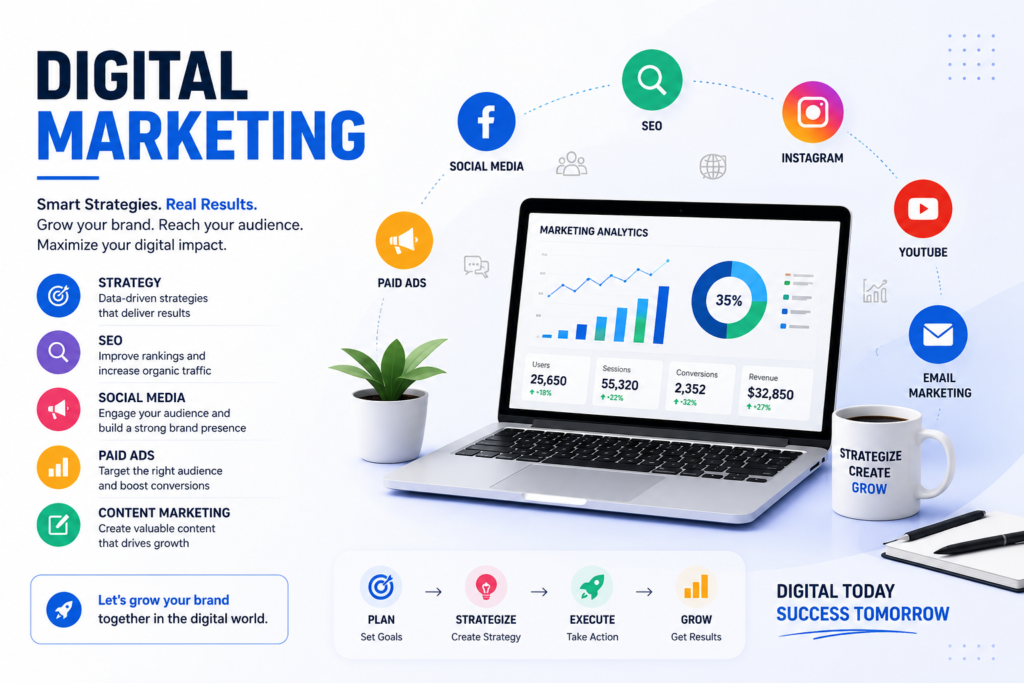
Some of the most important digital marketing channels include:
- Search engine optimization (SEO)
- Social media marketing
- Content marketing
- Email marketing
- Google Business Profile
- Pay-per-click advertising
- Online advertising
- Influencer marketing
- Video marketing
- Website marketing
- Online reputation management
The biggest advantage is that small businesses can start with a limited budget and gradually increase their marketing investment as they generate results.
Why Is Digital Marketing Important for Small Businesses?
Large companies often have huge advertising budgets, but small businesses can still compete by using targeted digital marketing.
Here are some of the biggest benefits.
1. Reach More Potential Customers
Your potential customers are already spending time online. They search Google, watch YouTube videos, use Instagram, Facebook, LinkedIn, and other platforms.
Digital marketing helps your business appear where your customers are already looking.
For example, if someone searches for “best digital marketing agency near me,” a well-optimized business can appear in search results and potentially attract that customer.
2. Build Brand Awareness
People are more likely to trust a business they recognize.
Consistent social media posts, helpful blog articles, videos, advertisements, and a professional website can increase your brand visibility.
Over time, customers can become familiar with your business, services, products, and expertise.
3. Generate More Leads
A good digital marketing strategy does more than increase website traffic.
It should encourage visitors to take action.
For example, visitors can:
- Fill out a contact form
- Call your business
- Send a WhatsApp message
- Request a quotation
- Subscribe to your newsletter
- Book an appointment
- Purchase a product
These actions can turn website visitors into leads and eventually customers.
4. Reach the Right Audience
Traditional advertising can reach many people who may not be interested in your product or service.
Digital marketing allows you to target specific audiences based on factors such as location, interests, demographics, search behavior, and online activity.
This makes your marketing efforts more targeted and measurable.
5. Measure Your Results
One of the biggest advantages of digital marketing is measurement.
You can monitor metrics such as:
- Website traffic
- Search rankings
- Click-through rate
- Leads
- Conversion rate
- Social media engagement
- Advertising costs
- Sales
- Return on investment
This information helps you understand what is working and where you need to improve.
Best Digital Marketing Strategies for Small Business
There is no single strategy that works for every company. Your ideal approach depends on your industry, audience, location, budget, and business goals.
However, several digital marketing strategies can be useful for most small businesses.
1. Build a Professional Website
Your website is often the center of your online presence.
When someone discovers your business through Google, social media, an advertisement, or another channel, your website can provide more information and encourage them to take action.
A professional small business website should include:
- Clear homepage
- About Us page
- Products or services
- Contact page
- Business location
- Phone number
- Email address
- Customer reviews
- Clear calls to action
- Mobile-friendly design
- Fast loading speed
Your website should answer three basic questions quickly:
What do you offer?
Who do you help?
How can customers contact or buy from you?
A well-designed website can improve credibility and support your SEO and online marketing efforts.
2. Search Engine Optimization for Small Business
SEO for small business is one of the most valuable long-term digital marketing strategies.
Search engine optimization helps improve your website’s visibility in search engine results.
For example, a local bakery could target keywords such as:
- bakery near me
- best bakery in [city]
- birthday cake near me
- custom cakes in [city]
A digital marketing agency might target:
- digital marketing agency
- SEO services
- social media marketing services
- digital marketing for small business
The goal is not simply to add keywords to your website. You need to create useful content that satisfies what people are searching for.
Important SEO Practices
Focus on:
- Keyword research
- Search intent
- Helpful content
- SEO-friendly titles
- Meta descriptions
- Internal linking
- Image optimization
- Mobile usability
- Website speed
- Local SEO
- Quality backlinks
- Technical SEO
SEO usually takes time, but it can become a powerful source of consistent organic traffic.
3. Local SEO
If your business serves customers in a specific location, local SEO should be an important part of your digital marketing strategy.
Local SEO helps businesses become more visible when people search for products or services in their area.
For example:
“best gym in Greater Noida”
“digital marketing agency near me”
“best salon in Delhi”
“restaurant near me”
One of the most important tools for local businesses is a Google Business Profile.
Your profile should contain accurate information such as:
- Business name
- Address
- Phone number
- Website
- Opening hours
- Services
- Photos
- Business category
You should also encourage genuine customers to leave reviews and respond professionally to reviews.
Local SEO can be especially valuable for restaurants, salons, gyms, clinics, retail stores, repair services, real estate businesses, and other location-based companies.
4. Social Media Marketing
Social media marketing is another important part of digital marketing for small business.
Platforms such as Instagram, Facebook, LinkedIn, YouTube, and others can help businesses build relationships with their audiences.
However, you don’t necessarily need to be active on every platform.
Choose platforms where your target customers spend the most time.
Instagram can work well for:
- Fashion brands
- Fitness businesses
- Restaurants
- Beauty businesses
- Travel companies
- Personal brands
- Creative businesses
Content ideas include:
- Reels
- Product photos
- Behind-the-scenes content
- Customer testimonials
- Educational posts
- Before-and-after content
- FAQs
- Tips and tutorials
Facebook can be useful for local businesses, communities, events, offers, and customer communication.
LinkedIn is particularly useful for B2B companies, consultants, agencies, recruiters, professionals, and service providers.
YouTube
Video content can help businesses explain complicated products and services, answer customer questions, and build authority.
The key is consistency and value rather than simply posting promotional content every day.
5. Content Marketing
Content marketing for small business focuses on creating useful information that attracts and educates your target audience.
Instead of constantly telling people to buy something, you provide information that helps solve their problems.
For example, a digital marketing agency could publish:
- What Is SEO?
- How to Find the Right Keywords for Your Website
- Digital Marketing Trends
- How to Create a Digital Marketing Strategy
- Social Media Marketing Tips
- AI Tools for Digital Marketers
A fitness business could publish:
- Beginner Workout Guide
- High-Protein Food Ideas
- How Much Protein Do You Need?
- Strength Training Tips
Content marketing can support SEO, social media, email marketing, and brand authority at the same time.
6. Email Marketing
Email marketing remains useful for building long-term relationships with customers.
You can collect email addresses through your website by offering something valuable, such as:
- Discount
- Free guide
- Newsletter
- Checklist
- Consultation
- Educational resource
You can then send useful updates, promotions, educational content, product announcements, and personalized offers.
The goal should not be to send unnecessary emails. Focus on providing value.
7. Pay-Per-Click Advertising
SEO can take time. PPC advertising can help businesses generate visibility and traffic more quickly.
Search advertising allows businesses to bid on keywords related to their products or services.
For example, a plumbing company could advertise for searches related to emergency plumbing services.
A small business should start with a clearly defined budget and track conversions carefully.
Important metrics include:
- Cost per click
- Click-through rate
- Cost per lead
- Conversion rate
- Return on ad spend
Don’t simply measure how many people clicked an advertisement. Measure whether those clicks generated valuable business results.
8. Video Marketing
Video has become an important part of online marketing.
Small businesses can create simple videos using a smartphone.
You don’t always need expensive equipment.
Video ideas include:
- Product demonstrations
- Tutorials
- Customer testimonials
- Business introductions
- Frequently asked questions
- Behind-the-scenes videos
- Educational videos
- Short-form videos
You can repurpose one video across different platforms to save time.
How to Create a Digital Marketing Strategy for a Small Business
A successful digital marketing strategy starts with clear goals.
Follow these steps.
Step 1: Define Your Target Audience
Before creating content or advertisements, understand who you want to reach.
Consider:
- Age
- Location
- Interests
- Problems
- Buying behavior
- Income level
- Business needs
The more clearly you understand your audience, the easier it becomes to create relevant marketing.
Step 2: Set Clear Marketing Goals
Your goals should be specific.
For example:
- Increase website traffic
- Generate 50 leads per month
- Increase online sales
- Improve local search visibility
- Grow social media followers
- Increase brand awareness
Clear goals make it easier to measure performance.
Step 3: Perform Keyword Research
Keyword research helps you understand what your potential customers search for.
Start with your main service or product and identify related search terms.
For example, a small business marketing agency might target:
Primary keyword:
- digital marketing for small business
Related keywords:
- small business digital marketing
- digital marketing strategy
- digital marketing services
- SEO for small business
- local SEO
- social media marketing
- online marketing for small business
- digital marketing agency
- content marketing
Use these terms naturally in your content rather than repeating the same keyword excessively.
Step 4: Create Helpful Content
Create content based on your customers’ questions and problems.
A useful content strategy could include:
- Two blog posts per month
- Three to five social media posts per week
- Short-form videos
- Monthly email newsletter
- Customer case studies
Consistency is more important than creating a large amount of content at once.
Step 5: Optimize Your Website
Make sure your website is:
- Mobile-friendly
- Fast
- Easy to navigate
- Secure
- Search-engine friendly
- Easy to contact
Every important page should have a clear purpose and call to action.
Step 6: Track Your Performance
Use analytics and search tools to monitor performance.
Look at:
- Organic traffic
- Keyword rankings
- Leads
- Conversions
- Engagement
- Advertising performance
Then use the data to improve your strategy.
Common Digital Marketing Mistakes Small Businesses Should Avoid
Many small businesses invest time and money into digital marketing but don’t see good results because of avoidable mistakes.
Trying Everything at Once
You don’t need to use every marketing channel.
Start with two or three channels that match your audience.
Ignoring Local SEO
If you serve a local market, don’t ignore Google Business Profile and local search optimization.
Posting Without a Strategy
Random social media posts may generate activity but not necessarily business results.
Create content around clear goals.
Focusing Only on Selling
Constantly promoting products can make your audience lose interest.
Use a combination of educational, entertaining, informative, and promotional content.
Ignoring Mobile Users
A large portion of online activity happens on mobile devices.
Make sure your website works properly on smartphones.
Not Measuring Results
Without tracking, you won’t know which marketing activities are generating results.
How Much Does Digital Marketing Cost for a Small Business?
The cost of digital marketing depends on your industry, goals, competition, location, and strategy.
Some businesses start with organic marketing methods such as:
- SEO
- Social media
- Content marketing
- Email marketing
- Google Business Profile
Others invest in paid advertising.
A practical approach is to start with a manageable budget, measure the results, and increase investment in channels that demonstrate value.
The goal is not to spend the most money.
The goal is to achieve the best possible return from your marketing investment.
Digital Marketing for Small Business: A Simple 90-Day Plan
If you’re just starting, you don’t need a complicated strategy.
Month 1: Build Your Foundation
Focus on:
- Create or improve your website
- Set up Google Business Profile
- Research keywords
- Create social media profiles
- Identify your target audience
- Set marketing goals
- Create a content calendar
Month 2: Start Creating Content
Focus on:
- Publish SEO-friendly blog posts
- Create social media content
- Start collecting customer reviews
- Create short-form videos
- Build internal website links
- Improve local SEO
Month 3: Measure and Improve
Analyze:
- Website traffic
- Search rankings
- Leads
- Social media engagement
- Conversions
- Advertising performance
Identify what is working and invest more effort into those channels.
The Role of AI in Digital Marketing for Small Business
Artificial intelligence is changing how businesses create and manage marketing campaigns.
Small businesses can use AI tools to assist with:
- Content ideas
- Keyword research
- Social media captions
- Email drafts
- Customer research
- Data analysis
- Image creation
- Marketing automation
- Content optimization
However, AI should support your marketing strategy rather than replace human judgment.
Your content should still demonstrate experience, accuracy, originality, and genuine value.
Final Thoughts
Digital marketing for small business provides an opportunity to compete in today’s increasingly digital marketplace.
You don’t need a huge marketing budget to get started. What you need is a clear strategy, a defined target audience, useful content, a professional online presence, and consistent measurement.
Start with the fundamentals: build a good website, optimize it for search engines, create a Google Business Profile, use social media strategically, publish helpful content, and measure your results.
As your business grows, you can expand into paid advertising, email marketing, video marketing, marketing automation, and advanced SEO.
The most important thing is to start.
A consistent and customer-focused small business digital marketing strategy can help increase online visibility, attract qualified leads, build trust, and create sustainable business growth.
Ready to grow your business online? Start by choosing one digital marketing channel, creating a clear goal, and taking the first step today.
Hi, this is a comment.
To get started with moderating, editing, and deleting comments, please visit the Comments screen in the dashboard.
Commenter avatars come from Gravatar.